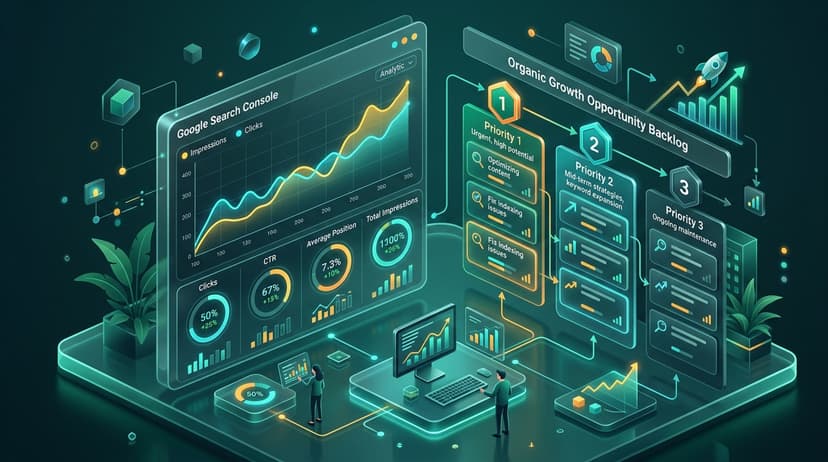
When a user clicks a result in Google, Google's servers record an immediate click event in the GSC database. The user's browser then initiates a DNS lookup, establishes a TLS handshake, downloads your HTML bundle, parses CSS, executes JavaScript, and finally fires the GA4 gtag.js beacon. Any failure along this multi-step journey (bounce, network timeout, ad blocker) creates a discrepancy.
Google Search Console vs GA4: why their numbers never match
A deep dive into telemetry, attribution models, consent banners, and privacy thresholds explaining analytics discrepancies.
EXECUTIVE SUMMARY
Core Strategic Takeaways
- Server-Side vs Client-Side telemetry: GSC records the intent click; GA4 records the successfully loaded page session.
- Consent banners block client analytics: Users rejecting cookies are invisible to GA4 but fully tracked in GSC.
- Single click can equal multiple sessions: A user bookmarking or reopening a tab can register several GA4 sessions from one GSC click.
- Privacy thresholds redact GSC long-tail queries: GSC hides rare individual queries to protect user privacy.
The Two Telemetry Boundaries
The Impact of Privacy Regulations and Consent Banners
Consent settings change what Analytics can observe. Basic consent mode blocks tags until consent; advanced mode can send cookieless signals and support modeling. A declined banner therefore does not imply a matching percentage of missing sessions. Search Console measures search activity separately, with anonymized queries and reporting limits; it is not a complete record of every query.
How to Reconcile the Discrepancy for Executive Reporting
Stop trying to make the two numbers match perfectly. Use Search Console to evaluate search market demand, ranking visibility, and indexing health. Use GA4 to evaluate post-click behavior, on-site engagement, product activation, and conversion pipeline.
DECISION MATRIX
Search Console vs GA4 Architectural Comparison
| Dimension | Google Search Console | Google Analytics 4 (GA4) | Key Business Takeaway | |
|---|---|---|---|---|
| Data Source | Google Server logs (pre-click & click) | Client-side JavaScript beacon (post-landing) | GSC sees total market demand; GA4 sees completed visits | Discovery analysis vs Behavioral analysis |
| Privacy Vulnerability | Immune to ad blockers and cookie rejection | Heavily impacted by consent management (CMP) | GA4 undercounts sessions by 15-35% | GSC is the true baseline for search interest |
| Query Transparency | Full keyword-level impressions and CTR | (not provided) hides 98% of query terms | Use GSC for SEO keywords, GA4 for page paths | Content strategy vs Conversion optimization |
APPLIED PRODUCTION CASE STUDY
Applied Case Study: Enterprise SaaS Resolves 42% Analytics Gap After Cookie Banner Redesign
Context:
A multinational software enterprise reported 100,000 monthly organic clicks in Search Console but only 58,000 organic sessions in GA4.
Identified Challenge:
The board questioned marketing ROI, suspecting click fraud or technical bot traffic inflating Search Console metrics.
Action Protocol:
The engineering team audited telemetry: discovered that a slow-loading cookie consent modal blocked the GA4 script for 4.2 seconds, causing 30% of mobile users to exit before analytics fired.
Measured Results (45 Days):
Migrating to asynchronous server-side tagging and optimizing banner rendering recovered 28,000 monthly sessions in GA4, restoring board confidence and proving true organic ROI.
ACTION CHECKLIST
Analytics Discrepancy Audit Checklist
Follow this 5-point protocol to audit and document analytics variances.
0 of 5 done
Calculate your baseline GSC-to-GA4 ratio
Establish your normal historical variance percentage across 90 days.
Audit Cookie Banner opt-in rates by country
Compare consent rates in GDPR regions against non-regulated regions.
Check Core Web Vitals and First Contentful Paint (FCP)
Ensure analytics tags load within 1.5 seconds to prevent drop-off loss.
Verify UTM parameters and referral leakage
Ensure internal redirects do not strip referrer headers and misclassify organic search as Direct.
Document data boundaries in executive reporting templates
Explicitly label GSC as "Search Intent Clicks" and GA4 as "Engaged On-Site Sessions".
EXPERT FAQ
Frequently Asked Questions
If a visitor bookmarks an organic landing page or reopens an idle browser tab after 30 minutes, GA4 logs a new organic session without generating a new click in Search Console.
GROVIQO PLATFORM TEST
Diagnose search intent overlap and cannibalization across your domain
Connect Google Search Console to detect query-flipping URLs, authority fragmentation, and AI-search citation readiness in minutes.